Showing posts with label japanese film. Show all posts

Wednesday, 28 December 2011

Дерсу Узала - A. Kurosawa

This is a split Russian-Japanese work directed by Akira Kurosawa in 1975, based on the memoirs by Russian explorer Vladimir Arsenyev and his travels through the course of years in Siberia.

The majority of the film is shot in the harsh yet beautiful wilderness of Siberia. Kurosawa and his team have exploited this landscape to their full advantages. I don't think many could pull this off today.

The main character in the film is a native of the forests, who is essentially a Siberian Tarzan, of the Nanai people. Throughout the film, we see the relationship formed between a military commander ordered to map the area and the native of the forests.

It's a fascinating film that allows us to question the basis of our society, and to realise that, compared to a more primitive lifestyle, age takes its tole on us all. The film shows the growth of friendship and respect between the two men, and says that fundamentally we all strive for the same necessities in life. All this couldn't of been accomplished without the sublime character study by the main actor Maksim Munzuk, from a small acting career, who plays Dersu so authentically.

Directed by Kurosawa, each frame has been carefully crafted to form this is flawless epic of a film, that takes real skill and admiration to pull of from the filming location alone. The choice of scenery and it's execution is phenomenal, drawing comparison to other adventurous works, such as those by Werner Herzog (Fiztcaralldo, Aguirre).

You won't find any pretense here -- just wonderful story telling by one of cinema's most cherished directors. This film has an obsessive appeal, but towards the scenes in the end of the film, you'll reach a realm of intensely emotional sorrow. You'll be left in awe with one of the most rewarding feelings you can receive from cinema.

If you've tried Kurosawa before but couldn't get on with his Samurai action films -- try Dersu Uzala, which depicts the drama of humanity itself.   

Sunday, 17 April 2011

羅生門 - Akira Kurosawa

Rashomon is a crime mystery film. It's always looked like a samurai film to me. I even thought Ikiru was likely to be a samurai film.

Being now my third Kurosawa film, I know it's not a "samurai film". It's hailed as one of his masterpieces, and stars the reckless Toshiro Mifune.

The majority of the film is told via flashbacks around a crime committed in the woods. We are set on lots of different paths, with accounts told from an array of characters, each one supposedly void of truth.

There is so much information on the film, making it an ideal essay for a film student, you can find: influences of silent film, modern art, how Kurosawa had the staff and actors live together, the use of light and minimal use of scenery to reflect upon all different symbolic and allegorical, profound meanings. There's even something dubbed the "Rashomon Effect", and writings that say the film is an allegory of the atomic bombing...

This is what makes reviewing classic film so difficult (or films that have been hailed as so influential): trying to find something honest to say when you just want to directly comment on how you enjoyed the film, avoiding regurgitating what has already been said.

Saturday, 9 April 2011

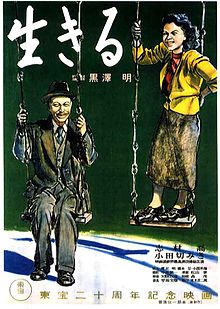
きる -- Akira Kurosawa

Ikiru is a Japanese film that was co-written and directed by Akira Kurosawa in 1952.

When I think of Akira Kurosawa, I always think of Samurai films. I've only seen Seven Samurai, which offers so much more depth; so much I needn't mention it.

Ikiru centres around a reclusive bureaucrat in Tokyo, living the same lifeless, monotonous lifestyle every day for 30 years.

We follow the man throughout his last days; learning he has stomach cancer and unable to empathise with anyone in his current life.  We join him on the final quest for a meaning to his life, to all our lives.

I wasn't entirely sure if a Japanese film from the 50s could be so moving with its conventional acting and script; I was convinced I was in for a cliched and dated film. I was wrong. It's also surprisingly long, running at 143 minutes, which is only to be expected from a film with such directional talent and profound message.

Now that I have seen it, I am certain that it will always be an important film, more than just an old warming tale from back then, and it will always find its way into any list constructed by anyone who knows film. It's perfect, and I don't think it intended to be.