Showing posts with label fantasy. Show all posts

Thursday, 18 September 2025

The Priory of the Orange Tree

 IKEA flat-pack fantasy: oversized, overhyped, and assembled without care. This is romantasy dressed in graduation robes it never earned. What we’ve got here is all bulk, no ballast. It’s epic only in word count, not in vision.


I didn't know anything about the book before reading it. I just heard it was a popular fantasy novel. That's allowed me to go in with an open mind and judge the book as I would any other. Based on the cover, I must admit I was expecting a dragon’s roar, but what I got instead was a long, weary yawn.


The prose uses choppy short sentences with faux-poetic minimalism that comes across as cheap and overused. It is not fantastical. Being just shy of 900 pages, instead of immersive fantasy details, it's full of mundane padding with characters eating breakfast and getting dressed.


The book has extremely weak male characters, both literally and in character development, and the worldbuilding is extremely flat, only going as far to flirt with a fantasy world amongst pages of the banal. The balance of attention to this work of fantasy feels anything but epic, drowned in the ordinary. Alongside the choppy sentences, Shannon injects an internal narration, which I feel is a lazy way to provide blunt clarity to her prose and does nothing to provide us with immersion and escapism that any good fantasy work should offer.


A consensus is that Orange Tree is a feminist successor to Tolkien's LOTR. We had a philologist at the helm building languages from scratch, pouring in Anglo-Saxon poetics, Norse saga structures, Catholic theology, medieval scholasticism and his WW1 trench experiences. Every song, map, poem, every invented name has roots in the mastery of his scholarship. The form (archaism, shifting registers, embedded poetry) matches the substance (myth, faith, loss, redemption).


To set that alongside Shannon’s book — with its short choppy sentences, pedestrian filler chapters, and flat characterisation — is almost obscene. It’s like putting Tolkien’s cathedral next to a prefabricated shed and calling them the same because they both have a roof.


Marketing loves to crown the ‘new Tolkien,’ but these comparisons are hollow. We had language, myth, theology, and form woven together. Without that depth, you don’t get a new Tolkien... you get pastiche wearing a crown it hasn’t earned, much like all the fantasy authors post-Tolkien that thought they could eat from the same bowl.


There is no doubt in my mind that many an author has been sent back to the editor with a manuscript this large. To strip the mundane, to provide a higher concentration of pacing and narrative, to hone and sculpt the story. This book got a free pass. It sees itself as a tapestry, but it’s just yards of plain cloth stitched together without pattern or colour.


Orange Tree is a 900 page banquet where every course is porridge: filling, repetitive, and never worth the fanfare. It’s twice the length it should be, and half the novel it needed to be.


Thursday, 11 September 2025

The Judging Eye - R. Scott Bakker


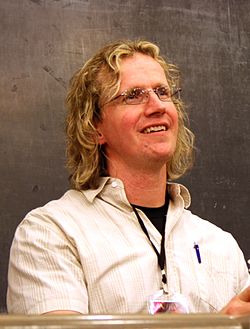
Bakker at SFeraKon 2009 

Picked this up because it clearly stated 'Book One' on the title page. Be nice if it said that on the cover. Also, nice if it said _anywhere_ that this a follow-up series. Either way, as an introduction to Bakker, this entry will suffice. I can at least see what the author's all about.


After a few italicised pages and then the mandatory fantasy Prologue, and then a further opening 20 pages of lore dumping, we’re introduced to our first character. First line of dialogue – lore and history. Continued dialogue in robotic voices reading encyclopaedic entries.

The characters first and foremost are simply mouthpieces for history and pseudo-philosophy. They don’t come across as people. He’ll set the scene with landscapes of doom, ancient wars, and “as the chronicles record…” before anyone actually breathes. It’s expository dialogue, and you slog your way through them speaking in dense prattling like pretentious grad students debating ontology instead of actual conversations.

Bakker manages to make his lore-dumping colleagues look rather tempered. It’s absolutely absurd with weaponised exposition. Pages full of laughable historic, geographic and personal names overwhelm the reader as the actual characters in his book are left frozen, static or even speaking. I had to double check a paragraph of it because I thought it was an encyclopaedia entry, but it was actually what appeared to be to be a child’s internal monologue, yet felt as if you’d walked into a lecture for an advanced class you hadn’t signed up for.

When we’re not subjected to such pontification, we’re left with juvenile Saturday morning cartoon dialogue. You’ll feel you’re reading an essay in a foreign language and then the dialogue from Scooby Doo will appear on the page, “his BOONSMEN. His father...! .... HIS FATHER! was there something he wasn't telling him?”  Talk about tonal whiplash. We shift from pseudo-biblical proclamations - a Silmarrilion of cosmic history - straight into cringe-melodrama. I’m surprised there’s not a few anime “NGHNNNNnnn”s in the text to colour the vibe. It’s hilarious. I don’t know if this is 1-star or 5-star material.

The character of Sorweel (also called Sorwa) was introduced in the first chapter, and in the opening paragraphs has been given three descriptive traits. Sad, miserable, depressed. These are used multiple times in describing him. No other attributes or traits are mentioned. Want to mention the characters finally moving over to the Barracks or stables? Quick little lore dump on both buildings respectively as they warm their hands. Bakker can’t resist, and so follows up on the mention of stables with a mini-essay on the anthropological and religious significance of horses in the ancient world of Sakarpi.

Rubbing their hands together around the fire to keep warm, no mention of the characters feeling cold at all, no mention of the fire crackling, or the mist in the air, or other people keeping warm. His father comes in with some dialogue, what are we expecting, a simple “cold night, isn’t it?” Don’t be silly. We get, “Moments of weakness come upon all men.”, just blurted out, like we’ve just sat down to warm ourselves and tuned in to a Radio 4 documentary.


This is what makes him so absurd: he never lets people just be people. Every action, every mundane object is smothered under gravitas and lore. The result is a book where characters can’t tie their boots without triggering a disquisition on the ancient boot-making traditions of three extinct tribes. And what do with have with our sole POV character, Sorweel? He’s less a character and more a container for Sadness™, Lore™, and Capitalised Platitudes™ and stunning and insightful dialogue mostly consisting of “Father?” … “Yes, son.” … dramatic pause… “noooooooooo!” when he’s not got his encyclopaedia at hand.

He's a hilarious excerpt:
“"are you such a fool, Sorwa?" the fact that the question was searching, genuine, and not meant as a reprimand cut Sorweel to the quick.”


Bakkerism at it’s finest there. A simple line of dialogue. A question. Instead of letting us judge tone, context, or body language — he tells us the “true meaning” of the line, as though he’s narrating a god’s-eye transcript of intentions and emotions. It’s not even subtle: he delivers it in bald, clinical prose, like a psychology report. No human conversation actually works that way. No reader needs their hand held to that degree — unless the dialogue is so weak it can’t stand without footnotes. This is total factual certainty about the hidden interiority of people who haven’t been developed enough for us to intuit anything ourselves. And how did Sorweel respond after the grandiose, psychological over-analysis?
“No, Father.” It's like 90s dubbed anime.

What about a little introspection? Look what happens when Sorweel simply looks out the window (and of course, judges the landscape as MISERABLE, because he himself is). Not just a simple dressing of the scenery and atmosphere, some visual tones, no, the rain and grassy slopes outside the window become a catapult into theology and esoteric ritual: suddenly we’re in Theological Exposition Hour: prayers of Gilgaol, Fate, the Whore, the Aspect-Emperor… all sparked because Sorweel glanced outside. Every mundane moment is hijacked by lore. Stables? Lore dump. Rain? Lore dump. Fire? Lore dump.

I don’t know if it’s unintentionally hilarious, or perhaps a parody of fantasy writing. No, Bakker’s deadly serious. There’s no winks or punchlines here. It’s like a classic B-movie trying so hard that it’s just slapstick comedy.

Conclusion:

The Judging Eye is a work where the author spends more time worldbuilding his footnotes than breathing life into his characters; a book that reads like someone translated a PhD dissertation into anime subtitles. Bakker writes as if story is beneath him. He wants to be taken as a philosopher who happens to wear a fantasy skin, but when he’s forced to do “human stuff,” it comes out stilted and drifts into the arena of comical absurdity.

Elric of Melniboné - Michael Moorcock


Moorcock is the punk rocker of fantasy. He's done for fantasy what Alan Moore did for comics, although he's never found that level of respect as far as being a household name goes.

Having read fantasy/sf (both old and new) over years, Moorcock was a name that fell under my radar here and there. Loyal yet discerning fans praise his work, and any author worth their salt will admire him at any given opportunity. The problem is that the limelight never shone brightly upon him, despite a prolific output over decades he's never had the commercial backing of the big names in the genre. His face didn't fit. 

Moorcock found success in the form of very cheap paperbacks, sold both on home soil and overseas (especially in areas like eastern Europe). Yet it was still very much (and still is) a more 'underground' following. 

He attacked fantasy clichés, including fantasy as an institution and its respective tropes. He worked with Blue Oyster Cult and Hawkwind. He distanced himself from the likes of Tolkien with a direct criticism in essay form.... and paid dearly for it. His works have never been published into the fat chunks readers over the decades wanted to hold. For example, my copy of this novel is one of those old old cheap paperbacks from the early 80's (very cool art on the cover). The publication history for his work is completely fragmented, sometimes requiring the reader to delve into the second hand market to read something out of print, and maybe even consult a reading order. It's not as strict as most series. These works were done on a budget and a time constraint, somewhat like the works of Howard and Lovecraft from the pulp magazine era.  

This novel is under 200pgs, yet you certainly won't feel short-changed. Whilst it is from the early 70's (or at least published into book form in '72), it's unlike anything from that era of fantasy (and tropes we still endure today). We're introduced to Elric, a brilliant anti-hero reminscent of modern-day offerings like Geralt of Rivia. There's emotional and moral conflict, the nature of fate and free will, and characterisation that for me is far more interesting than a good vs. evil romp.

The writing and prose isn't bad, either (although Moorcock was capable of far more grandiose novels). In fact, it's probably a higher bar than the popular fantasy of today. 

The Way of Kings

The Stormlight Archive #1 - "The Way of Kings" by Brandon Sanderson


I suppose this is me having another crack at trying to delve into a large fantasy series. Something I can really lose myself in. A capsule I can swallow every day and be entire submerged inside a world where the escapism on offer leaves me blind to the reality of my own life. That's the attraction. After GRRM's failure the deliver further story to his magnum opus, in the span of 15 years since his last entry, I and perhaps numerous other fans looked for a new home and a younger more proflific horse to back.

Sanderson looked the part. He'd won respect in the fantasy world for at least going out there and finishing off Jordan's Wheel of Time. He'd created a heuristic guide for magic systems in fantasy works. Within the field of the 'modern' fantasy author having found success, his writing ability and prose could have, possibly, been adjacent to GRRM, at least that's what I'd hoped and speculated. I thought the narrative here was that the genre had indeed matured and started to embrace higher literary standards, even if that was as fundamental as avoiding tropes and stereotypical hero characters. 

After all, if you want to make it big, you want to start rubbing shoulders with the world of TV and turning the right heads. You'd want to convince that world that your work isn't ripe for saturday morning cartoons, but a gritty adult TV series full of political scheming and devoid of juvenile Disney wizards and caped heroes. That you'd of course respect Tolkien from an academic perspective, yet were very much part of the evolotion of fantasy and were lightning years away from sons of blacksmiths on quests to destroy ancient, evil 
rings and swords and nasty goblins! 

I like my dragons and I like my dungeons. If an author wishing to write fantasy feels that these bastions of post-Tolkien fantasy are weathered relics best left in low budget 80s movies, and wants to work with more 'mature' material (I've heard incest is all the rage nowadays), I'll buy into that as well.  

This review encompasses the first couple books of this series. Technically, this meant that I had read 4 published books that are split into respective parts 1 & 2, totalling over 2000 pages which each 'tome' approx. 500-700pgs.

Sanderson's prose is functional. There's nothing fantastical or poetic here. This choice (or dare I say limitation of the author) does however offer an impressive amount of clarity and accessibility to the reader. After all, this isn't writing to fawn or marvel over from an academic, wine-tasting position. These are tomes to plough through half-asleep before bed or on your daily commute. The world building and plot were also serviceable, yet after hundreds of pages you might find, like myself, that this wasn't time well spent, and perhaps a false investment.

Moden day fantasy authors like Sanderson seem to be far more interested in finding the longest possible way to tell their stories and build the worlds these characters live in, a lá R. Jordan. A modest trilogy just doesn't cut it when you and your publisher can print a 14-part series, breaking down each entry into several volumes.

The introduction of further POV characters isn't irksome in itself, but seemed to provide Sanderson with another trick to prolong any sense of urgency in driving home any cohesive narrative, to the point that different character arcs predominated in existence only to deny the reader a sense of progress and very much a 'two steps back' reining in of the plot.

There also lacks any sense of intrigue or mystery, with rudimentary flashbacks showcasing an order of soldiers; forshadowing where our POV characters are going to end up; a glimpse of where the plot will inevitably go, but barred off until you've read another thousand pages or purchased sufficient amount of volumes.

Of course, fans that have handed over hours of their reading quota to Sanderson will no doubt cry 'just keep going, it gets good by book 7!' (or is that 3-4 1000 page books?) and for most of us, this isn't a marriage we're willing to enter. Hopefully my review helps the reader make an informed decision so that said marriage might come across as more consensual.

The Stormlight Archive currently sits at a total of 5 books and 3 novellas. Sanderson's said the 'latter half' of this series is still to come, so there will be at least another 5 novels (or 5000 pages). Of course, if this wasn't enough commitment for the reader -- Sanderson's "Cosmere" universe now spans across several series which no doubt are all (perhaps gently) interconnected.

This is very much a 'turn back, dragons ahead' response from me.
 

House of the Dragon


This is less of a constructive review of this TV series, and more a reflective bemusement that carries on me burying the demon that was ASOIAF. I couldn't exactly forget HotD, the illegitimate spawn from HBO, so allow me to prepare an unmarked grave next to the giant that once was.

After the Game of Thrones TV series ended, HBO no doubt felt they weren't financially satiated. Their bellies still grumbled, and their pockets demanded more. Again, much like the false hope we've all had to adopt for GRRM giving us Winds of Winter over the years, HotD amongst all the other rumoured spin-off shows could not only give us viewers more of the same, but perhaps cleanse our memories of the insulting end to the main show. It was a known and working foruma, and for some reason the source material now being a completed 'work' by GRRM (no doubt the master of the side quest) we avoid the writers bringing a 'the dog author ate my homework' to the table. 

The short of it is: 

  • Season 1 was really quite good. Reminiscent of the highs that GoT itself provided.
  • Season 2 comes around, and decides to slam on the brakes and throw the source material out the window.

It seems that you can give modern showrunners/writers all the ingredients and a working forumla. You can show them the mistakes of those that came before. You give them a safety net and a harness. You can even just throw money at a problem. 

Only this time, those given the keys to the show and acting roles dislike fantasy even more than those last time round. I always found it bizarre how many of the actors from the GoT show never bothered to pick up the books. Careers were born out of that show. Names were made. Childhoolds were spent. The adults and teenagers both had no interest in reading what it was all about. Not even a mild curiosity. What makes HotD even worse, is that the showrunners and directors themselves also have no love for the genre. No, they didn't want dragons. They didn't want fire and blood. They didn't want civil war and political scheming. They wanted to inject moden-day LGBT romances into a plot that never had any and do it under the umbrella of HBO and the success that came before.

Imagine being given the green light to adapt a really high budget historical adaption of the Wars of the Roses and it turns out the writers are actually solely interested in a couple woman they/theman from both the houses of York and Lancaster getting intimate. Cast the source material aside and use it for kindling. 

Any complaints, any audience backlash? Simple. Empowerment is your friend. Just declare all criticism as homophobia, cut another season short and continue to serve the dish that nobody wants. If they don't like it, tell them fantasy adaptions are a saturated market and if their bigoted little brains don't like it they can go and watch The Rings of Power instead. Not a fan of that either? The Wheel of Time or the Witcher, perhaps? Whole new meaning of 'cancel culture' there. Enjoy. Whether it be HBO, Amazon or Netflix steering the ship, this is apparently the best us dirty fantasy nerds deserve.

A Song of Ice And Fire


A household name, yet for all the wrong reasons. It's almost impossible to mention this attempt at a fantasy series (and that's what it is - an attempt) without mentioning the sour taste the TV show left in many a mouth. Without these books, there'd be no household name for this series thanks to the global success of the TV show. Ultimately, the bastardisation of that show only has the books to thank for that. Adaptors of media needs source material as a painter needs canvas.

Despite enjoying what content GRRM provided the reader over thousands of pages (myself very much included), when we regrettably let the dust settle on these books over the years (decades?) and pretend the TV adaption never happened, we can take a far more objective stance to the books as exclusive entities based upon fundamental writing categories and respective qualities and achievement.

Much like the TV show, the first three books were thoroughly enjoyable. GRRM's prose is far more elaborate and skillful in these pages, displaying a far greater degree of aptitude than his other fantasy series contemporaries. Characterisation and narratives are nuanced with an emphasis and balance of moral, ethics, and cultural attitudes. GRRM managed to break down the doors of fantasy tropes, but ultimately his siege upon the cliches of the genre became his undoing. The once praised complexities in plots became his grave as he dug down so far he could no longer see the surface. There were no limits to the number of characters written to the page, no constraint or discipline to refrain from fractals of subplot. The man wrote himself into the ground in the deepest, darkest hole and took us all along a journey into that abyss with him.

His rebellious leanings towards standard fantasy hero fare (now in hindsight) proved devoid of logic or substance. He hadn't killed off just another character, but entire the narrative. Characters still remaining in the story are mere husks, tumbleweeds gently rolling over Essos as Westeros still returns a 404 error. After the events of ASOS, the entire civil war plot (the only plot to have light at the end of the tunnel) came to a crashing halt, and birthed the narrative monstrosities that were AFFC and ADWD respectively. Apologies to readers were printed in some publications, with an explanation in ADWD that around the first half of that book takes place the same time as the prior entry. AFFC is simply that. Sustenance, arguably, but hardly a feast for the eyes of the reader, who's tricked into believing that world building alone can carry a story.

Perhaps that's what it was really all about: a false hope. By the time you've read what may well be the final entry of this series, GRRM has let the Ice melt and the Fire burn out many moons ago. The dust has settled, the flame has dwindled and finally one's emotional attachment to the world of Ice and Fire passes with those last dying embers. What once were vast hordes of fans storming through these pages have in turn fallen into the same pit GRRM so eagerly dug for us.

What's left is a false legacy. A TV adaption that overtook it's source material. An author disinterested in his life's work. Yet most importantly ASOIAF no doubt provides us all with a greater lesson: only start what you intend to finish. Like any student involved in many a discipline, this work is one of those greater historical mistakes that all who intend to follow must learn by the mistakes of those that came before. These books are the Chernobyl of fantasy literature.

Friday, 20 March 2020

Castlevania TV Series

Castlevania - Netflix TV Series - Warren Ellis


Castlevania is a video game series by Konami, but in this post, we're discussing the Netflix animated series produced written by comic book legend, Warren Ellis. I have watched the currently available three seasons, and eagerly await the fourth. As the reader, you will find this post spoiler-free.

I can't ignore the origins of the series, which is worth discussing. Castlevania: Symphony of the Night, released back on the PlayStation 1 in 1997, is hailed as one of the best video games of all time. However, the first two seasons of Castlevania adapt a much earlier game in the series, Castlevania III that was released way in 1989 on the original Nintendo (NES), which received moderate reviews.

Honestly... whether you have an interest in video games at all, let alone Castlevania, is irrelevant. I for one have played only a few hours of the first Nintendo DS release, Dawn of Sorrow, and whilst I enjoy it as a game, as I do Nintendo's Metroid games of the same genre, I find them difficult -- even more so on a handheld system as I suffer from hand cramps when using them.

Castlevania is a strange thing to adapt, especially from the third game in 1989, as video games weren't known for their storytelling prowess back in the 8-bit era. In fact, the third season adapts the 2005 entry, Curse of Darkness, which was released on the PlayStation 2. which actually received mixed reviews.

There is a dark fantasy world depicted in these games, of which the series boasts a whopping thrity-one titles. The games are feature vampires, vampire slayers, curses, monsters, monster slayers... but also quite a lot of video game lore, which for a series spanning multiple decades, isn't surprising.

What is surprising, is that the games haven't seen a release since 2014's Castlevania: Lords of Shadow 2, from the PlayStation 3 era, and that Konami, insead of giving gamers a new Castlevania title in this now six year hiatus, instead decided to produce an animated TV series distributed by Netflix.

What surprises me me, as a comic book fan, especially of Warren Ellis and his work on comic series like Transmetropolitan, Hellblazer, and X-Men, is that via my research, I've discovered that Ellis didn't even know what Castlevania was when this was pitched to him twelve years ago. The main thing of note wrote Ellis' works, is that he has written for Marvel animated series before, and even the widely acclaimed horror video game, Dead Space.

My surprise doesn't end there. My fiancée, who is not an avid comic book fan, or gamer, marathoned the entire series on Netflix, and wanted to rewatch it with me.

Nor does my surprise even end there. I was surprised at how good the quality of the writing was: the plot; the turns and twists; and, the characterisation and quality of English voice acting from The Hobbits'  Richard Armitage and Graham McTavish, amongst others delivered so well.

Whilst produced by experienced Japanese animators, Castlevania doesn't feel like Japanese anime (of which I am not an expert), with all its usual tropes and clichés. I actually felt that the quality of writing was on par with Game of Thrones' first four seasons.

We had a climactic finish in the first season that opened the story up to a wild, spiral of plotting and intrigue, followed by excitement and wonder throughout. We have character redemptions, and characters portrayed as truly grey: neither atypical evil villians or good heroes. Of course, each episode is condensed into a mere twenty minute run time, and the first season is only four episodes, but such constraints for me now make sense as to why they hired Ellis with his experience of writing Dead Space and comic book issues.

This is a true gem of a well-written series, whether you have an interest or not in video games, comic books, or animation. I think after the bitterly sour taste that the ending of Game of Thrones still leaves me with, there is more to explore in what you could call an alternative to big budget media.

Animated series, video games, and comic books: I feel this is their time to be noticed now more than ever as a salvation for the storytelling abilities power house productions have failed to achieve. They are a viable solution in tackling the greed, egos and overall derailing we saw from the directors and celebrity actors in larger budget releases, and the aforementioned areas are ones where I certainly am going to be dwelling in for a while, and perhaps blogging more about with an open mind.   

Monday, 22 April 2019

Game of Thrones TV Series - A Rant

Game of Thrones TV Series - A Rant


If anyone reads this: it's riddled with spoilers if you haven't watched the show yet.

Image result for game of thrones tv series

Isaac Wright has played Brandon Stark, a character from the Game of Thrones TV series, since he was 10 years old. Isaac is now 20. For half his life, he has portrayed this character in a fictional world. A world of fantasy, which at first glance for an outsider of GoT may look like period drama, until they see the dragons.

As a watcher of this show, (and a reader of all the current books in the A Song of Ice and Fire series by George RR Martin), in its latest incarnation I have to remind myself its by HBO. The same company that gave us The Wire, Sopranos, Boardwalk Empire, Oz, Band of Brothers, and Rome. All great shows and the very upper echelons of drama and character development.

When the show was first in my radar, I knew it was going to be more than some fantasy trope. It's HBO! The first 4 seasons were based on the author's work - intelligent writing - and for the most part, quite well (and loyally) adapted. I didn't even mind some of the changes or combining characters into one. The sets were great, the characters were fully fleshed out, believable, the costumes looked the part. The production value was high enough. What really got me interested was the drama and the political scheming and the backstabbing. It wasn't for the sake of it, either. It's all inspired by medival-type history such of Wars of the Roses (Starks vs Lannisters), Alexander the Great (Danaerys), the Glencoe Massacare (Red WeddinG), Genghis Khan (Dothraki), etc.

As I write this, there are currently 4 episodes of this show left. I can't believe the popularity this show has garnered. To see how many people enjoy it, to see how much of a household name. It's even the most pirated 'thing' in Intenert history. It screams money.  So why the hell are we having it butchered?

I understand that they have overtaken the author. Go and consult him for your writing. GRRM used to write an episode per season back in the day: I'm sure he can give you something to work with. He's even said he believes HBO needed at least 13 seasons to truly capture his story, not 8, with the last one cut short to 6 episodes.

The show ultimately failed to give us the Dorne storyline we deserved. Oberyn was adepted well to screen, and yes, the actress from Rome playing Elaria Sand is a good actress, who, after attending the trial in King's Landing, failed to be in any storyline that matted and was merely involved with sub-sub-sub plots that the show writers have fabricated. Arianne Martell. Give us Arianne Martell or don't give us anyone. Either way, aside from Oberyn they made the entire Dorne storyline up. The sandsnakes felt like I was watching Xena Warrior Princess. And not in a good way. You can't switch to 80s Hollywood corny fight scenes with people throwing one liners. You've already set the tone and standard for this show. They quickly learnt their lesson, and wiped out anyone from Dorne. They originally weren't even going to bother with Dorne.

Stannis. Shireen story. Terrible, made up. Fabricated. That's his fucking heir. Sigh. This is actually another character that exists in the books, and this didn't even happen to them. You gave us Stannis, you made up some bullshit, then you discarded him. The latter two are your own creation.We deserved so much more. 

Littlefinger. Fantastic actor, but again, that's all these show runners really care about. Can they act? Can they emote? Great! Write their story to convience us. Littlefinger is meant to be charming. That's how he wins people around. The writers fabricated a terrible storyline with off-screen logic to it anyway.

Remember the Tyrells, back in season 5? Are we just expected to believe an entire house is eliminated? It's all very convienient. 

The Greyjoys! No Victarion, no Damphair. And the cherry on top - Euron! Abomination of character portrayal. The writing is already done for you. What you have put on screen, is not only terrible, but has no justification. Euron has sailed around the known world. He has gone into the ruins of Valeria, and made it out alive. He drinks essense of nightshade, and is evil, yes, and twisted, yes, but he's also got intelligence. He doesn't come across as some fratboy prat making sexual jokes. Who the hell is this on screen - it's not Euron is any shape or form... and for *no* apparent reason I can think of. There's no quick win or advantage to be found butchering a character.

Arya being shanked multiple times in the gut, yet is running around the next episode. Intelligent tevevision and writing there, from the same show that brought us the Red Wedding. You can guess which the author of the books wrote...

What really irritates me about a lot of these mistakes is that they have characters that we've seen on screen for so long act out of character. Jaime's redemption arc, Theon's collapse, Sansa's maturity - all handled really well - believable.

The reason I write this blog post is because I wanted to say I'm calling it here: I think Game of Thrones is going to be hailed, after it's finished, as the best show that ended the worst. Season 5 onwards gave us sloppy writing, bad decisions, fabricated plots, and kept the casual watchers coming back for more as they'd give us an action-heavy episode per season, a lá "Battle of the Bastards" or "The Spoils of War".

We aren't getting the supposed extended episodes. We are getting fan service. The pacing... it's so completely rushed and force. Remember the Ygritte and Jon romance? A little bit more believable, isn't it? Watching Danny and Jon fly around on dragons is like I'm watching Aladin - some Disney cartoon. It's also like watching forced breeding. Why are we having this show rushed again? Do you think GRRM is rushing his books despite all the pressure upon him? If they went at a slower pace and built up the world and characters more they could have done the series the justice it deserved. They have betrayed the fans by basically finishing off the series, as they are sick of trying to write episodes when they have no source material. It's as simple as that. More importantly, they're terrible writers. 

In 4 hours of screen time, that's in 4 weeks, this entire mess will be concluded. The mess they created since season 5. I'm sure we'll get some big-budget action scenes, because that's been the redeeming quality of this show now. Write a bunch of crap, give the idiots a big action episode, and keep them coming back for more, just like the same audience is perfectly happy attending the latest Marvel superhero movies. Nothing wrong with superhero movies, just something very wrong when a show dealing with great characters and writing turns into one.